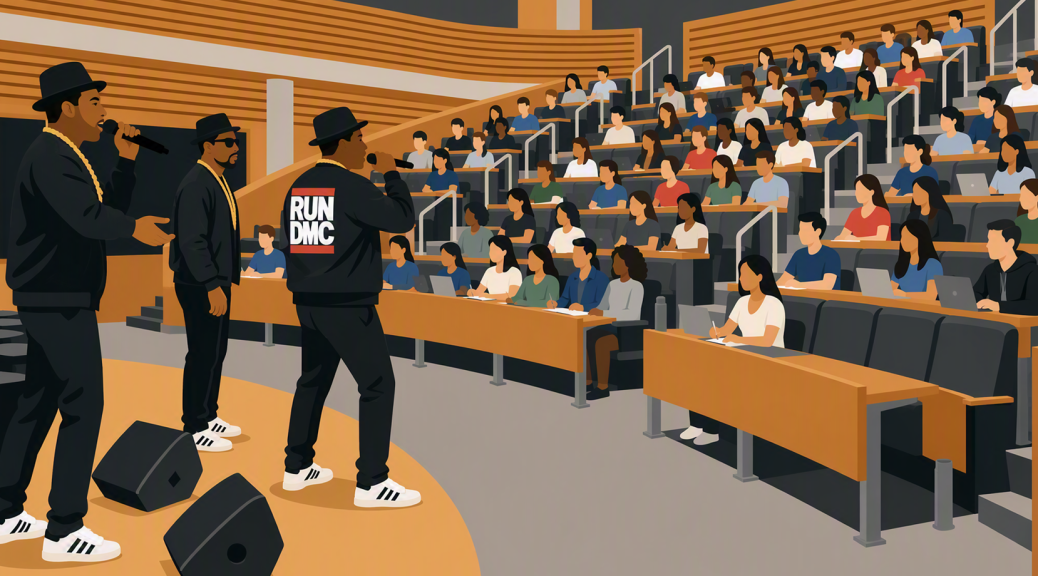
From “Hard Times” to “The Breaks”: How Old-School Hip-Hop Evolved into a Powerful Influence on Higher Education
Hip-hop began as a response to crisis, but it developed into a sophisticated cultural system for making meaning, building community, and teaching people how to analyze the world around them. Histories of hip-hop culture trace its emergence to Bronx block parties in the 1970s, especially the 1973 Back-to-School Jam organized by Cindy Campbell and DJ Kool Herc. Scholarship on hip-hop education similarly emphasizes that the culture grew from postindustrial conditions affecting Black and Latino communities in New York City (Petchauer, 2009; Thomas, 2023). In that sense, hip-hop was pedagogical before universities named it as such. It taught through rhythm, participation, memory, critique, and performance.
That origin story matters for higher education because many practices now associated with effective college teaching, including student voice, belonging, collaborative knowledge construction, culturally relevant learning, and public argument, have long been embedded in hip-hop culture. Research suggests that hip-hop pedagogy can encourage inclusion, self-expression, student-instructor engagement, and connections between academic learning and community change (Hains et al., 2021). Tracing this influence through landmark rap recordings reveals how different stages in the development of hip-hop expanded the possibilities of teaching and learning.
From Visibility to Legitimacy: “Rapper’s Delight” and “The Breaks”
The first crucial shift in the history of recorded rap was visibility. The Sugarhill Gang’s “Rapper’s Delight” was the first rap song to achieve mainstream success on the pop charts and helped build a large-scale market for hip-hop (Encyclopaedia Britannica, n.d.-b; Reese, n.d.). Although hip-hop culture had developed for years in local performance spaces, the record introduced rap music to listeners far beyond the block-party circuit and demonstrated that the form could travel through commercial media (Summers et al., 2023).
For higher education, visibility often precedes institutional legitimacy. “Rapper’s Delight” gave future teachers and scholars an accessible entry point for treating rap as language, poetics, oral tradition, and cultural archive. Its crossover success did not create hip-hop’s intellectual value, but it made that value harder for established institutions to ignore. Later educational scholarship would frame hip-hop culture as central to questions of literacy, identity, curriculum, and social context (Petchauer, 2009).
Kurtis Blow’s “The Breaks” helped transform visibility into recognition. The song became the first rap recording certified gold by the Recording Industry Association of America and helped push rap music further into radio and mainstream markets (Saponara, 2020). Its achievement offers a useful lesson for higher education: cultural legitimacy is frequently negotiated through systems of recognition that were not designed by the communities producing the culture. Studying that process helps students question who defines academic value, how canons are built, and why some forms of knowledge must prove themselves repeatedly before institutions take them seriously.
Critical Literacy and Social Analysis: “The Message”
If “Rapper’s Delight” and “The Breaks” expanded the audience for rap music, Grandmaster Flash and the Furious Five’s “The Message” expanded its public purpose. According to Bunnell (n.d.), the 1982 recording marked a turning point in rap music, shifting the form from primarily party-centered themes toward more direct social observation. Its later addition to the National Recording Registry further affirmed its importance to American cultural history.
In a college classroom, “The Message” can function as a text for both close reading and social analysis. Students can examine imagery, tone, point of view, historical context, and rhetorical purpose while considering how the recording represents structural inequality. The song demonstrates that aesthetic form and critical inquiry do not have to be separated. This connection is consistent with research finding that hip-hop pedagogy can create learner-centered spaces in which students connect course content with social conditions and community concerns (Hains et al., 2021).
Innovation and Interdisciplinary Learning: “Planet Rock”
Afrika Bambaataa and the Soulsonic Force’s “Planet Rock” illustrates another dimension of hip-hop’s educational value: technological and aesthetic experimentation. Released in 1982, the recording fused rap vocals with synthesizers, electronic textures, and drum-machine production, becoming an important reference point for electro and later dance and hip-hop styles (Encyclopaedia Britannica, n.d.-a; Songfacts, n.d.-b).
In higher education, “Planet Rock” supports interdisciplinary inquiry. It can be studied through music history, media production, digital culture, Afrofuturism, design, and transnational influence. Students might analyze how artists borrow, adapt, and transform existing sounds, then connect those processes to remixing, citation practices, intellectual property, and iterative design. Villanueva (2022) similarly argues that critical hip-hop pedagogy can connect cultural analysis, media, identity, community empowerment, and scholarship across disciplinary boundaries.
Rhetoric, Academic Voice, and the New School: “Hard Times” and “Sucker M.C.’s”
Run-D.M.C.’s “Hard Times” and “Sucker M.C.’s” mark a sharper turn in rap music’s formal and rhetorical development. Originally recorded by Kurtis Blow, “Hard Times” was reinterpreted by Run-D.M.C. with a stripped-down sound that shifted attention from melody toward the drum machine, vocals, and the realities described in the song. The track brought social struggle into the group’s emerging new-school style, using direct language to address economic pressure and the difficult conditions surrounding everyday life. Encyclopaedia Britannica describes “It’s Like That” and “Sucker M.C.’s” as a groundbreaking release defined by a spare, forceful rhythm track and overlapping vocals (Encyclopaedia Britannica, n.d.-c). At the same time, the Rock & Roll Hall of Fame situates Run-D.M.C. as a major force in bringing hip-hop into the cultural mainstream through a hard-edged style and new-school sensibility (Rock & Roll Hall of Fame, n.d.).
Together, the tracks demonstrate two complementary dimensions of academic voice. “Hard Times” shows how an effective communicator can translate lived experience and social conditions into a clear public statement. “Sucker M.C.’s” demonstrates how a speaker establishes authority through precision, delivery, confidence, and structure. The records do not depend on excess; they use rhythmic economy and direct language to make their ideas memorable. These are also qualities college educators seek in student writing and speaking: a clear voice, purposeful style, audience awareness, credible evidence, and command of form.
Pedagogically, “Hard Times” can introduce critical reflection on how economic conditions shape educational access, persistence, and opportunity (Sprague, 2024). Students might examine how the recording transforms hardship into testimony, then connect its themes to research on college affordability, student employment, food insecurity, or unequal access to academic resources. “Sucker M.C.’s,” by contrast, can support lessons in argument, rhetorical credibility, and performance. Hip-hop pedagogy scholars argue that the culture’s educational power lies not only in analyzing rap lyrics but also in practicing its active forms of creation and delivery (Lee, 2020). Students could therefore compose and perform concise arguments that combine evidence, personal voice, and audience awareness.
It is also worth noting that “Sucker M.C.’s” unexpectedly gestures toward higher education within the recording itself, with D.M.C. referencing St. John’s University. Later commentary has connected that reference to Darryl McDaniels’s real-life college acceptance. Whether heard autobiographically or symbolically, the moment reinforces that old-school hip-hop was never as anti-intellectual as some stereotypes suggest. Paired with “Hard Times,” it presents education not as a world removed from struggle but as one possible response to it. Knowledge, resilience, skill, and credibility become interconnected. Together, the songs offer higher education a compelling lesson: academic voice becomes most powerful when learners can name the conditions shaping their lives and communicate their knowledge with clarity, confidence, and purpose.
Civic Learning and Public Argument: Straight Outta Compton and “Fight the Power”
By the late 1980s, hip-hop had become a major cultural platform for public argument, with rap music serving as one of its most visible forms of expression. According to Westhoff (n.d.), Straight Outta Compton was a landmark 1988 album that helped popularize gangsta rap and became a defining work of the genre. The album centered a regional perspective and challenged national audiences to confront experiences, institutions, and conflicts that were often excluded from mainstream narratives.
In higher education, Straight Outta Compton can support difficult but important inquiry into representation, censorship, policing, regional identity, media framing, and institutional backlash. Responsible instruction should neither celebrate every claim uncritically nor dismiss the work because it is provocative. Instead, students can evaluate how the album constructs reality, how audiences interpret cultural testimony, and why particular forms of critique generate moral panic. Critical hip-hop pedagogy offers a framework for connecting those questions to race, power, inequality, and social change (Rose, 2018; Villanueva, 2022).
Public Enemy’s “Fight the Power” makes hip-hop’s civic function even more explicit. Created for Spike Lee’s 1989 film Do the Right Thing, the song became a defining protest recording tied to the racial and political tensions represented in the film and in American public life (Hertweck, 2018). It models hip-hop culture as a form of public argument by combining rap vocals, sampling, historical references, rhythm, and repetition into a demand for public attention.
For colleges that emphasize civic engagement and public-facing scholarship, “Fight the Power” provides a case study in multimodal rhetoric. Students can ask how music persuades, how protest art circulates, whose histories are invoked, and how an argument changes when it is heard in a film, at a demonstration, or in a classroom. Such analysis can move civic learning beyond abstract terminology and toward careful engagement with the forms through which communities actually debate power.
Storytelling, Composition, and Ethical Imagination: “Children’s Story”
Slick Rick’s “Children’s Story” demonstrates rap music’s narrative craft. Rolling Stone describes the recording as foundational to storytelling rap, while other sources document its enduring influence through extensive sampling and reinterpretation (Weingarten, 2018; WhoSampled, n.d.). The song uses pacing, characterization, escalating conflict, and consequence to build a cautionary narrative in only a few minutes.
For composition and writing studies, the recording offers a compact model of point of view, sequence, tension, audience expectation, and ethical framing. Students can map its narrative arc, compare the narrator’s voice with the perspectives of its characters, or adapt the story into another medium while explaining their rhetorical choices. This approach treats students as makers rather than passive recipients. It also aligns with critical hip-hop rhetoric work in first-year writing, which draws on culturally grounded language and rhetorical practices to support student success (Stone & Stewart, 2016).
From Records to Learning Design
The educational influence of these recordings is strongest when instructors move beyond simply placing a rap song on a syllabus. Hip-hop pedagogy asks faculty to consider how the broader culture organizes participation. The cypher, for example, offers a model of reciprocal contribution in which participants gather in a circle to exchange ideas, stories, rhymes, or performances, with each person building on what others have contributed. Rather than relying on a single authority figure, the cypher emphasizes active listening, improvisation, mutual respect, and shared knowledge creation. Participants gain credibility through meaningful contributions while also supporting the learning and expression of others. In educational settings, this structure can be adapted to classroom discussions, collaborative problem-solving, and peer-to-peer learning, creating opportunities for students to engage as co-creators of knowledge rather than passive recipients of information. Research on a university-based critical hip-hop pedagogy course found that cypher-based structures expanded opportunities for students to participate in knowledge production and helped preservice teachers reconsider their own educational practice (Rose, 2018).
This does not mean every course needs student rap performances. It means instructors can adapt hip-hop’s underlying cultural practices: sampling as purposeful synthesis, remixing as revision, the cypher as collaborative dialogue, storytelling as knowledge construction, and call-and-response as rapid feedback. These methods can be applied in composition, education, communication, history, media studies, and technology-rich learning environments. The goal is not to make higher education appear trendy. It is to recognize hip-hop as a cultural and intellectual tradition with its own rigorous approaches to inquiry and creation.
Conclusion: From Struggle to Scholarship
Taken together, these recordings chart an extraordinary evolution in rap music and its role within hip-hop culture. “Rapper’s Delight” expanded rap music’s visibility. “The Breaks” demonstrated its commercial legitimacy. “The Message” advanced its capacity for critical literacy and social analysis. “Planet Rock” expanded hip-hop’s technological imagination. “Hard Times” and “Sucker M.C.’s” sharpened rap’s rhetorical voice. Straight Outta Compton and “Fight the Power” intensified rap’s role as a vehicle for forceful public argument. “Children’s Story” offered a master class in narrative composition. Each recording widened what rap music could accomplish within the broader development of hip-hop culture, and each capacity now offers something valuable to higher education.
What colleges draw from old-school hip-hop, then, is more than topical relevance or nostalgia. They encounter a pedagogy rooted in struggle, invention, critique, voice, and community. Hip-hop’s journey from hard times to higher education reflects the fact that the culture developed rigorous ways of teaching people to observe, interpret, perform, revise, and respond to the world. Universities are not simply adding rap music to the syllabus. At their best, they are learning from hip-hop as a culture that has been producing knowledge all along.
References
Bunnell, R. (n.d.). The Message: Grandmaster Flash and the Furious Five (1982). Library of Congress, National Recording Preservation Board. https://www.loc.gov/static/programs/national-recording-preservation-board/documents/TheMessage.pdf
Encyclopaedia Britannica. (n.d.-a). Afrika Bambaataa. https://www.britannica.com/biography/Afrika-Bambaataa
Encyclopaedia Britannica. (n.d.-b). The Sugarhill Gang. https://www.britannica.com/topic/the-Sugarhill-Gang
Encyclopaedia Britannica. (n.d.-c). Run-DMC. https://www.britannica.com/topic/Run-DMC
Hains, B. J., Salazar, J., Hains, K. D., & Hill, J. C. (2021). If you don’t know, now you know: Utilizing hip-hop pedagogy as a tool for promoting change in students and community. Journal of Education, 201(2), 116–125. https://doi.org/10.1177/0022057420904368
Hertweck, N. (2018, March 3). “Fight the power”: 7 facts behind Public Enemy’s anthem. GRAMMY.com. https://www.grammy.com/news/fight-power-7-facts-behind-public-enemys-anthem-grammy-hall-fame/
Lee, M. A. (2020). Hip-hop practice as pedagogy. Review of Education, Pedagogy, and Cultural Studies, 42(5), 409–426. https://doi.org/10.1080/10714413.2020.1835724
Petchauer, E. (2009). Framing and reviewing hip-hop educational research. Review of Educational Research, 79(2), 946–978. https://doi.org/10.3102/0034654308330967
Reese, E. (n.d.). “Rapper’s Delight”: Sugarhill Gang (1979). Library of Congress, National Recording Preservation Board. https://www.loc.gov/static/programs/national-recording-preservation-board/documents/RappersDelight.pdf
Rose, C. E. (2018). “What really goes on”: Exploring a university-based critical hip-hop pedagogy teacher education course [Doctoral dissertation, Teachers College, Columbia University]. ERIC. https://eric.ed.gov/?id=ED586723
Saponara, M. (2020, June 14). 40 years of “The Breaks”: Kurtis Blow remembers the “dream world” surrounding rap’s first gold hit. Billboard. https://www.billboard.com/music/rb-hip-hop/kurtis-blow-the-breaks-anniversary-9401176/
Sprague, D. (2024, March 30). How Run-D.M.C. revolutionized hip-hop in 1984: Looking back on 40 years of the rap trio’s seminal debut. Rock and Roll Globe. https://rockandrollglobe.com/rap/how-run-d-m-c-revolutionized-hip-hop-in-1984/
Songfacts. (n.d.-a). Children’s Story by Slick Rick. https://www.songfacts.com/facts/slick-rick/childrens-story
Songfacts. (n.d.-b). Planet Rock by Afrika Bambaataa & the Soulsonic Force. https://www.songfacts.com/facts/afrika-bambaataa-the-soulsonic-force/planet-rock
Stone, B. J., & Stewart, S. (2016). HBCUs and writing programs: Critical hip hop language pedagogy and first-year student success. Composition Studies, 44(2), 183–186. https://www.jstor.org/stable/24859540
Summers, J., Lonsdorf, K., & Jarenwattananon, P. (2023, August 8). “Rapper’s Delight”: How hip-hop got its first record deal. NPR Illinois. https://www.nprillinois.org/2023-08-08/rappers-delight-how-hip-hop-got-its-first-record-deal
Thomas, B. A. (2023, August 11). How hip-hop was born 50 years ago at a block party in the Bronx. Smithsonian Magazine. https://www.smithsonianmag.com/smithsonian-institution/how-the-block-party-became-an-urban-phenomenon-180980560/
Villanueva, G. (2022). You must learn: Sampling critical hip hop pedagogy in communication education spaces. Pedagogy, Culture & Society, 30(4), 435–453. https://doi.org/10.1080/14681366.2020.1801819
Weingarten, C. R. (2018, November 27). Best of ’88: Slick Rick on the greatest story hip-hop ever told. Rolling Stone. https://www.rollingstone.com/music/music-news/best-of-88-slick-rick-childrens-story-758567/
Westhoff, B. (n.d.). Straight Outta Compton: N.W.A (1988). Library of Congress, National Recording Preservation Board. https://www.loc.gov/static/programs/national-recording-preservation-board/documents/StraightOuttaCompton.pdf
WhoSampled. (n.d.). Children’s Story by Slick Rick. https://www.whosampled.com/Slick-Rick/Children%27s-Story/