Linen Bindings and Lost Thesis Statements: Wes Anderson and the Pedagogy of the Prop Book
In the meticulously curated dioramas that constitute a Wes Anderson film, every object in the frame is a character. Perhaps no objects are more vital to his visual vocabulary than the prop books. These aren’t just background fillers; they are tactile, linen-bound artifacts with bespoke typography and weathered dust jackets that signal a deep, albeit quirky, reverence for the printed word. From the scholarly rigor of The Royal Tenenbaums to the archival obsession of The Grand Budapest Hotel, Anderson’s prop books function as symbols of a “lost” higher education—a version of academia that prioritizes the weight of a physical volume and the idiosyncratic pursuit of specialized knowledge over the digital efficiency of the modern world.
The Syllabus of the Andersonian Hero
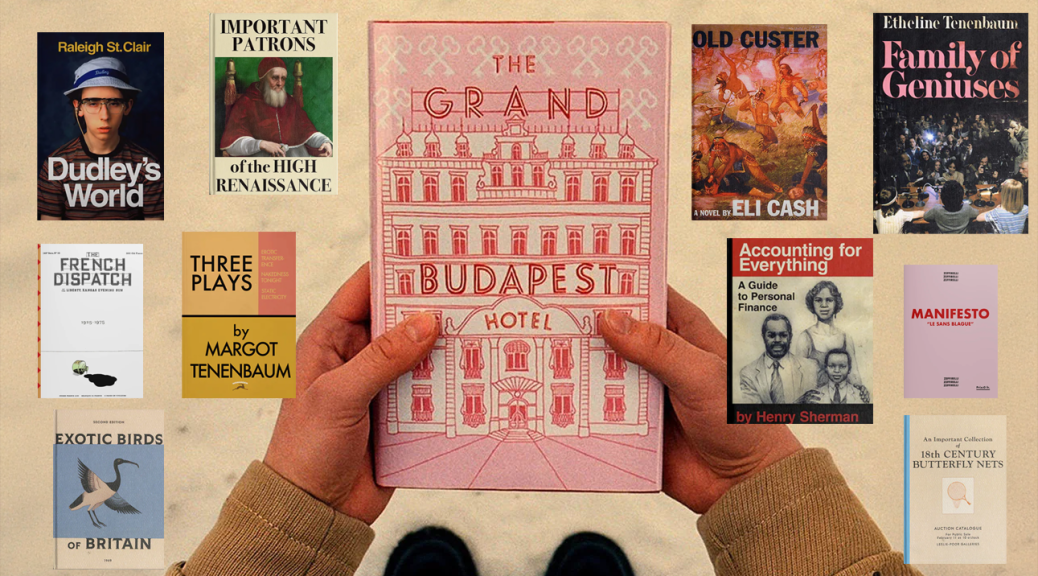
In Anderson’s universe, a character’s intellect is often measured by their personal library. Consider Margot Tenenbaum’s Three Plays and her secretive literary career, or the Heaven and Hell play by Max Fischer that helps define his extracurricular identity in Rushmore. These books function as a form of self‑directed higher education—a concept well‑established in research on self‑directed learning, which emphasizes learner autonomy, self‑management, and intentional control over one’s own educational trajectory (Smith, 2021). In a university setting, we are taught to engage with a canon; in an Anderson film, characters construct their own canons through intentional acts of selection, study, and engagement. The books serve as credentials. When we see a character clutching a copy of The Grand Budapest Hotel or Anatole “Zsa‑Zsa” Korda from The Phoenician Scheme reading Important Patrons of the High Renaissance, we aren’t just seeing a prop; we are seeing a thesis statement of that character’s academic soul. Eli Cash’s faux‑western Old Custer—a custom dust jacket over an unrelated book—imagines Custer surviving Little Bighorn and serves mainly as Eli’s self‑made intellectual persona.
This mirror image of the university experience suggests that true learning often happens in the margins—in the independent study projects we assign ourselves when the official curriculum feels too narrow.
Anderson’s characters are often ‘over‑educated’ in subjects that don’t technically exist, yet they treat these fictional disciplines with the gravity of a tenure‑track professor. This reflects the hyper‑specialization often found in doctoral programs. In The Life Aquatic with Steve Zissou, the crew’s reliance on outdated manuals and oceanographic texts feels less like a practical maritime operation and more like a graduate department clinging to its preferred methodology. The books are symbols of rigorous, if somewhat obsolete, intellectual discipline. They represent the “deep dive” that defines higher education—the moment a student stops looking at the general overview and starts obsessing over the granular details of a specific, perhaps even obscure, niche, much like a film studies course that devotes an entire unit to examining how use of lateral tracking shots, diegetic book inserts, and meticulously symmetrical compositions collectively construct authorship, requiring students to analyze scene‑level stylistic patterns rather than broad thematic summaries.
A Bibliography of the Imaginary
The titles Anderson creates for his films often sound like the specific, niche monographs one might find in the basement of a prestigious Ivy League library, evoking a sense of “Old World” scholarship in which the goal isn’t just to learn, but to master a tiny, beautiful corner of the universe. The 27‑Year Itch by Raleigh St. Clair acts as a nod to the psychological case studies that dominated mid‑century social sciences, highlighting the clinical gaze of the researcher, while Family of Geniuses by Etheline Tenenbaum provides a meta‑commentary on the burden of high‑achievement culture within academia and the “prodigy” narrative often pushed in elite institutions.
In The Grand Budapest Hotel, the titular book attributed to “The Author” operates as a carefully constructed frame narrative that treats history as something archival—curated, edited, and bound in a manner that implies both authority and fragility. The text presents itself as a meticulously compiled account, complete with prefatory notes and layered temporal perspectives. In doing so, it resembles a kind of historical‑literary artifact: a book that not only records events but also shapes how they are remembered, suggesting that memory becomes official once it is organized into chapters, stabilized on the page, and granted the veneer of scholarly legitimacy. This treatment of narrative as a structured pedagogical tool mirrors the role of Coping with the Very Troubled Child, another invented volume whose mid‑century, clinically styled approach to child‑development pedagogy emphasizes behavioral management, emotional regulation strategies, and the belief that individuals—like histories—can be shaped through careful, prescriptive intervention. Both texts imply that written frameworks, whether for understanding the past or guiding childhood development, function as authoritative systems for interpreting complex human behavior. Even the various sections of The French Dispatch—such as “The Concrete Masterpiece” or “Revisions to a Manifesto”—extend this motif, each formatted like a polished academic essay appearing in a rigorously edited literary journal, further underscoring Anderson’s fascination with how print culture attempts to organize unruly experiences into legible, curated forms.
These titles are more than just clever Easter eggs; they function as the “required reading” for the audience. To understand the character, you must understand their bibliography. In the same way a thoughtfully designed curriculum reveals the sequence of concepts, competencies, and questions that shape a student’s intellectual development, the spines of these books tell us exactly what learning pathways a character has followed and which ideas have become central to their worldview.
The Aesthetic of Inquiry and the Research Toil
For those of us in or pursuing higher education, these books resonate because they romanticize the toil of research. In the real world, academia can feel like a mountain of PDFs, broken JSTOR links, and sterile computer screens. Anderson replaces this with the physicality of learning. His books are always slightly frayed at the edges, suggesting they have been checked out of a library a thousand times; their spines cracked by the weight of intense study. This aesthetic also addresses the loneliness of scholarship. Research in the humanities is often a solitary act, a quiet dialogue between a reader and a writer who may have died decades ago. In Moonrise Kingdom, when Suzy Bishop carries her suitcase full of stolen library books, she isn’t just carrying entertainment; she is carrying a portable university. She uses these stories—fictional accounts of magic and adventure—as a framework for understanding her own reality. This is exactly what we ask students to do in the humanities: to use literature as an analytical tool, much like in a well‑designed course where students select a single novel, film, or archival document and repeatedly apply different interpretive frameworks—historical criticism one week, feminist theory the next, then narrative analysis—to see how each lens reshapes their understanding of the real‑world questions the course is built around.
Preserving the “Paper” University
Ultimately, these prop books act as a defense mechanism against the sterilization of information. In higher education, there is a constant tension between the “useful” and the “ornamental.” Anderson leans heavily into the latter, arguing that the way we present knowledge—the font, the binding, the color of the paper—is just as important as the data itself. He treats the fictional book as a sacred object, much like a doctoral candidate treats their first published paper or their leather-bound dissertation.
This “Paper University” is a place where history is tactile. In The Royal Tenenbaums, the transition of the book from a bright, polished edition to a dusty hardback represents the aging of knowledge. It reminds us that, in the world of academia, we are all just temporary custodians of ideas. Anderson’s prop books are a tribute to the institutions that house such knowledge—libraries, archives, and universities—and a reminder that even if the information inside is fictional, the pursuit of it is deeply noble and deeply human. It is an acknowledgment that our education is not just about what we know, but about the artifacts we leave behind to prove we were here.
References:
Anderson, W. (Director). (1998). Rushmore [Film]. Touchstone Pictures; American Empirical Pictures.
Anderson, W. (Director). (2001). The Royal Tenenbaums [Film]. Touchstone Pictures; American Empirical Pictures.
Anderson, W. (Director). (2004). The Life Aquatic with Steve Zissou [Film]. Touchstone Pictures; American Empirical Pictures.
Anderson, W. (Director). (2012). Moonrise Kingdom [Film]. Focus Features; Indian Paintbrush.
Anderson, W. (Director). (2014). The Grand Budapest Hotel [Film]. Fox Searchlight Pictures; Indian Paintbrush.
Anderson, W. (Director). (2021). The French Dispatch [Film]. Searchlight Pictures; Indian Paintbrush.
Smith, T. (2021). Self-directed learning. EBSCO Research Starters. [ebsco.com]
Anderson, W. (Director). (2025). The Phoenician Scheme [Film]. Focus Features; Indian Paintbrush.