Summer Bucket List: Refresh Your Course (Site)
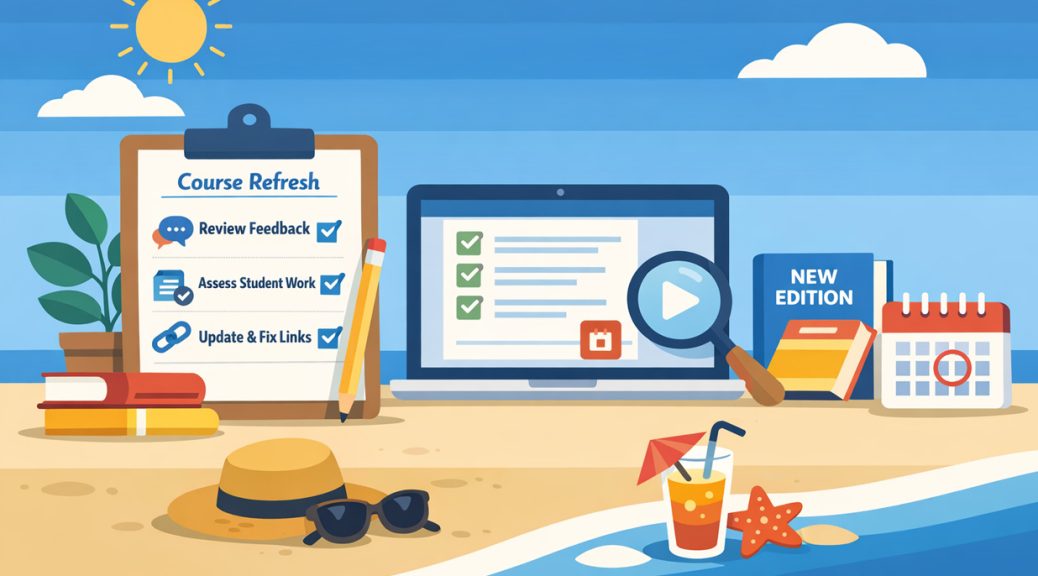
Cheers to another successful academic term! The semester is over, final grades have been submitted, and the long-anticipated summer is here. Now with some time removed from day-to-day teaching, here is an online course refresh checklist you can use to cross off your summer bucket list long before the fall term comes back around.
This summer course refresh list starts with more holistic course components, such as learning objectives and assessments, then moves onto more granular and quick checklist tasks, such as updating links and dates.
Start here: Review student course feedback.
A solid place to begin considering how to refresh an online course is by referring to the experiences of your students in the latest offerings of your course(s). Course evaluations are completed by students through Loyola’s SmartEvals, a course evaluation tool supported by the Office of Institutional Research and Analysis (OIRA). Student feedback collected through SmartEvals is anonymous and provides valuable insights from the perspective of user experience with course-related technology and offers student reflections on learning activities. Since course evaluation feedback prompts open-ended questions, students can identify and share specific components of their course experience or course design that worked—or didn’t—throughout the term.
Reflect on student submitted work and assessment.
Another source of insight for course revisions comes from reflecting on completed assignments and assessments: student submitted coursework. Since each course and discipline can vary widely in how student learning is assessed, instructors can review a student submission in terms of an assignment’s expressed learning objectives and consider the alignment of that assignment’s learning objectives have within the larger contexts of the course and of the program.
Reflecting on and ensuring how learning objectives align with larger student learning contexts and your pedagogical practice as an instructor are part of Loyola’s ongoing work with Coordinated Learning Assessment Supports.
As you review your assignments and their corresponding student submissions, you can consider some of these questions:
- Did the student(s) do well on this assignment? If they did, which responses or parts of their submissions indicate their achievement of the assignment’s learning objectives? If they did not do well on the assignment, do you notice any patterns in response across students?
- Can you clearly connect the assignment with the course content it is supposed to assess (e.g., readings, learning activities, class meetings, etc.)?
- What areas of the assignment posed the greatest difficulty to students? Are there ways to revise these areas to be more clear or attainable?
Quick update checklist.
Update text(s) and citations. Is there a new version of a textbook you use? Has an article changed its DOI or access location? (Bonus: A Loyola librarian would be an excellent person to contact as a resource if you find yourself with questions regarding text access in your course.)
Update audiovisual materials. Are there prerecorded lectures that you need to copy over from a previous course and/or rerecord to reflect new data? Do you have questions on how to manage your audiovisual content in Panopto? Meet with a team member from Learning Technologies & Innovation to develop an approach to Panopto folder organization with clear labels to reference or archive content in OneDrive.
Update hyperlinks. The internet shifts its content locations quite often—do a quick audit of your course hyperlinks and update any 404s or missing web content in your course.
Apply dates for the upcoming term. If you have already received a course assignment with times and dates for your course, apply the new dates in your course calendar and learning management system (LMS) tools.
Reach out for support.
If you find yourself overwhelmed by this course refresh process, please know that our faculty support structures at Loyola are around to help throughout the season:
Technical support for learning technologies is available through Learning Technologies & Innovation.
Course content, research, and references support is available through University Libraries.
Faculty support with pedagogy and course development is available through the Center for Faculty Development.