The Lip Case and the Question of Patentability
The Lip Case began the way a lot of small ideas do. With an “aha” moment. According to the story, Hailey Bieber was in a meeting when she started sticking her lip gloss to the back of her phone’s suction case. Inspired by the concept of having her gloss products fused into her phone, she quickly got to making it real. The Lip Case eventually became one of Rhode’s most recognizable products. It was even named a Best Invention of 2024 by TIME.
Then, in April 2025, the U.S. Patent and Trademark Office granted Rhode U.S. Patent No. 12,273,475 for its phone case. A patent is a government-granted right to exclude others from making, using, or selling the claimed invention for a limited time. Critics might look at the Lip Case and wonder whether its design seems too simple for patent protection. So, how exactly did it qualify?
The answer has nothing to do with how impressive the product looks in viral marketing, influencer selfies, or in stores. It has everything to do with what the patent application actually claims (the specific legal language that spells out what’s protected) and whether that language satisfies patent law’s requirements.
“This looks simple” and “this isn’t patentable” are two very different statements. Rhode’s Lip Case provides an opportunity to illustrate why an invention’s simplicity should not be confused with obviousness and how an ordinary consumer product can warrant patent protection.
A central question is not simply whether Rhode’s Lip Case looks like a phone case with a lip gloss holder. It is whether the particular way Rhode designed that case was novel (meaning the claimed invention was new) and nonobvious (meaning the claimed invention was not obvious to a person having ordinary skill in the relevant field) when it sought patent protection.
Patentability involves other requirements, including patentable subject matter and utility, but those issues are outside the scope of this article. The focus here is solely on novelty and nonobviousness.
Meet the Lip Case
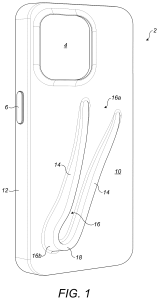
U.S. Patent No. 12,273,475, titled Case for a Mobile Telephone, was filed in April 2024 and granted in April 2025 to HRBeauty, LLC, the Bieber-led company.
At first glance, it would be easy to describe Rhode’s invention as a phone case that holds a lip gloss. But that description is narrower than what Rhode actually patented— lip gloss is not even mentioned in the claim. The patent’s description mentions lip gloss as one example of the kind of small personal item the groove might hold. So technically, Rhode didn’t patent “a phone case for lip gloss.” What is patented is the specific mechanical structure that happens to be marketedaround lip gloss. The distinction matters because patent protection extends to what an inventor actually claims, not simply to the general idea behind a product.
Claim 1, for example, describes a case or other body with a particular inner and outer surface. On the outer surface are two retaining elements that extend outward and form a groove between them. The retaining elements are made of flexible material that gradually increase in height toward one end of the groove and converge toward each other. The groove is open at one end and is designed to retain an item between the two elements. To simplify, Rhode’s patent is about a phone case with a particular way of holding an item on its exterior.
A different phone case that simply used a pocket or a separate detachable pouch could hold lip gloss without necessarily having the claimed retaining groove structure.
Does the Lip Case Qualify for Patent Protection?
Whether the Lip Case qualifies for patent protection depends on its claims, not its commercial appearance. Phone cases, lip products, and products designed to hold other objects all existed before Rhode. The key question is what, if anything, makes Rhode’s claimed combination novel (whether the claimed invention was new) and nonobvious (whether the claimed invention would have been obvious to a person having ordinary skill in the relevant field).
What Already Existed: The Prior Art
Before asking whether Rhode’s invention was novel and nonobvious, we must first ask: what was already out there? Every patent application gets examined by a Patent Examiner at the United States Patent and Trademark Office against “prior art” (everything publicly known or available before the application was filed).
Rhode’s patent cites several earlier patents, but that list is only a starting point. Relevant prior art may include unlisted sources and need not look exactly like the Lip Case. The question is whether a prior reference discloses every claimed feature or whether the prior art would have made Rhode’s combination obvious.
For example, imagine shopping for a phone case before Rhode’s Lip Case existed. You could already find cases with card slots, phone grips, stands, mounts, and other add-ons. You could also find products made to hold small personal items, including cosmetics. These inventions are prior art. Any and all prior art is considered when applications are reviewed, regardless of whether Rhode only included some of them as patent references.
Keep reading to find out how novelty and nonobviousness compare the patent claims with prior art in different ways.
Novelty: Was the Claimed Invention New?
A single prior art reference defeats novelty only if it discloses every element of Rhode’s claimed invention. General similarity is not enough. So, did any individual prior art reference already disclose the invention Rhode actually claimed?
This means looking at the specific limitations in the claims (not simply asking whether someone had previously made a phone case that held something). Remember Claim 1? It requires more than a phone case and more than a holder. It describes a particular retaining groove arrangement, including flexible retaining elements that increase in height, converge toward one end, and leave the groove open at the other end.
A useful prior art example from the Lip Case patent is U.S. Patent No. 2016/0007705, which described a phone case with an outer pouch for holding reading glasses. The pouch was attached to the case using tracks and rails. So, imagine putting reading glasses into a small pocket that is attached to the back of your phone case. That reference had several features in common with Rhode’s claim like a phone case, an outer surface structure, and a mechanism for holding another item. But it did not disclose Rhode’s particular pair of flexible retaining elements forming a converging groove that changes in height toward one end. Because a single reference must disclose every relevant limitation to defeat novelty, this reference does not defeat novelty for Rhode’s patent.
Ultimately, the examiners found that no prior art reference disclosed every claimed limitation. So, Rhode’s claims satisfied the novelty requirement.But that does not end the patent eligibility analysis.

Nonobviousness: Was the Claimed Combination Obvious?
Nonobviousness is the harder question because multiple prior art references may be considered together. Even if no single reference discloses every limitation, a claim may still be obvious if someone skilled in the field would have combined the known features in the way Rhode claimed.
This is where the intuitive reaction to the Lip Case becomes more compelling. Someone might reasonably look at the product and think: phone cases existed, lip products existed, holders existed. Why wouldn’t someone simply put those things together?
The Supreme Court addressed this in KSR International Co. v. Teleflex Inc. (2007). The Court explained that a combination can be obvious when a person having ordinary skill in the art has a reason to combine known elements and the combination yields predictable results. But the analysis cannot rely on hindsight. The question is whether an ordinarily skilled person in the relevant trade, faced with the prior art, would have had reason to arrive at the claimed combination.
Once we know Rhode’s product exists, the combination can seem almost inevitable. Of course a phone case could hold lip gloss. Of course a groove could be designed to keep it in place. But hindsight is not the test.
The earlier example also contributes to the nonobviousness analysis. Recall the phone case with an outside pouch and tracks and rails that keep the pouch attached. Now imagine asking a designer to create a holder for lip gloss. There are many possible ways to do that. The designer could use a pouch, a clip, a pocket, rails, or some other structure. Rhode chose two flexible retaining pieces that create a groove, become taller toward one end, and move closer together. The question under patent law is not whether a designer could have come up with that arrangement after seeing Rhode’s product. The question is whether the earlier technology would have given that designer a reason to make those particular choices in the first place.
Under KSR, familiar components do not make a combination obvious unless someone skilled in the field would have had reason to combine them in that way with predictable results. The prior art discussed here does not clearly point to Rhode’s flexible, converging retaining groove design, helping explain why the USPTO allowed the claims.
Rhode’s Lip Case Meets the Standards for Patent Protection
The point is that Rhode’s patent covers a specific structure, not the broad concept of attaching lip gloss to a phone. Another phone case would infringe only if it falls within the boundaries of at least one patent claim.The criticism that the Lip Case “looks simple” is understandable. But simplicity of appearance is not the same thing as obviousness in patent law. A product can look simple while containing a particular arrangement of features that was not previously disclosed or would not have been obvious to a person having ordinary skill in the art.
At the same time, calling an invention “creative” or “clever” does not establish nonobviousness either. This brings the analysis back to where it started: the claims.
The Lip Case may have started with a simple “aha” moment, but patentability turns on what Rhode claimed, what already existed, and whether its combination would have been obvious at the time.
On the two requirements examined here, novelty and nonobviousness, the Rhode patent presents a strong case for protection. The prior art discussed above does not disclose every element of the claimed structure in a single reference, and the particular retaining groove configuration is not shown to be an obvious combination of the earlier features. Those points explain why a product that looks simple can still satisfy two of the most important requirements for patent protection.

Georgette Helo
Assistant Blogger
Loyola University Chicago School of Law, J.D. ‘27