In Zootopia 2, Judy Hopps, a rabbit police officer, and Nick Wilde, a fox and Hopps’s former adversary turned partner, uncover a secret regarding the history of their city, Zootopia. For generations, a powerful family—the Lynxleys—has received credit for Zootopia’s most important invention, the “weather wall.” The weather wall technology makes it possible for animals from very different climates to coexist within one city, albeit with several distinct environmental districts. More specifically, the weather walls allow neighboring districts with drastically different climates, such as an arctic tundra and a desert, to exist side by side by separately regulating each district’s temperature and weather conditions.
There is just one problem. Spoiler alert: the Lynxleys did not invent it.
Judy, Nick, and Gary De’Snake, a mysterious snake, eventually discover that Gary’s great-grandmother, Agnes De’Snake, invented the weather walls. Agnes accordingly received a “patent of authorship.” But when she approached a Lynxley family member, Ebenezer, for financial help, he stole her plans. Ebenezer removed the patent from Agnes’s journal and took credit for the invention himself. With his wealth and prominent position in Zootopia, Ebenezer’s version of events was accepted, while Agnes went uncredited.
While the movie continues to explore the aftermath of these events, it serves as an introduction to the world of intellectual property law, specifically patent law. But the movie’s portrayal is not entirely accurate. This article uses Agnes’s story to explain inventorship, patent ownership, the evidentiary value of her journal, and why possessing a physical patent document would neither transfer ownership nor revive expired rights.
IP? What’s that?
Intellectual property refers to legal rights that protect certain creations of the mind, including inventions, creative works, brands, and designs. One form of IP is a patent, a property right granted by the federal government for a qualifying invention. A patentable invention must fall within patent-eligible subject matter, be useful, be new or “novel,” be nonobvious, and be described with enough detail to show how the invention works. A patent gives its owner the right to exclude others from making, using, selling, offering to sell, or importing the patented invention.
If “patent of authorship” sounds unfamiliar, that is because it is not legal term of art in U.S. patent law. The film uses the phrase as a fictional plot device. But the fictional document raises several real legal questions: Who qualifies as an inventor? How is inventorship different from ownership? What happens if someone falsely claims another person’s invention as their own? And how much does a physical patent document actually matter?
Patent law varies by country. For purposes of this article, however, Zootopia’s patent system will be analyzed under U.S. patent law.
The Lynxleys and the Weather Walls: Inventors, Owners, or Neither?
An inventor is a person who contributes to creating the invention. Patent law focuses on a concept called conception, meaning the inventor must form a sufficiently definite idea of how the invention will work. It requires more than recognizing a problem, suggesting a goal, or saying what the finished product should accomplish. Funding an invention, manufacturing an invention, or helping sell an invention does not by itself make someone an inventor.
A patent must correctly identify its inventor or inventors. Incorrect inventorship may invalidate a patent unless the error is corrected. Patent law provides procedures for adding an omitted inventor or removing someone who did not contribute to the claimed invention. Naming the wrong person puts the patent at risk of being invalidated or becoming unenforceable unless the error is formally corrected.
Applying those rules, Agnes appears to be the sole inventor. The film shows her developing the weather wall technology and asking Ebenezer only for financial backing; it does not show him contributing to its conception.
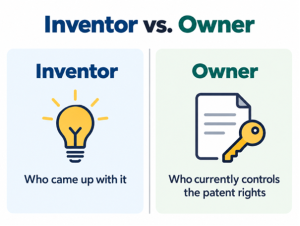
Although Ebenezer would not qualify as an inventor, he could still claim that he became the owner. That distinction matters because inventorship and ownership are separate concepts. A patent owner may transfer ownership to another person or company through an assignment, which is generally a written legal transfer of patent rights. Once those rights are assigned, the new owner may hold and enforce the patent even though someone else remains the inventor.
If Agnes had validly assigned her patent rights to Ebenezer, he could have owned and enforced the patent even though Agnes would still remain the inventor. But nothing in the movie suggests that Agnes ever legally transferred those rights to him. Instead, Ebenezer simply took her plans and physical patent document without permission, which would not constitute a valid assignment. Because there is no indication that Agnes transferred ownership of the patent rights, she would remain the patent owner.
Agnes Kept the Receipts—but What Did They Prove?
In Agnes’s case, her journal could provide evidence that she developed the weather-wall technology. The movie places enormous importance on possession of Agnes’s journal and the missing “patent of authorship” document, relying on those physical documents to establish inventorship. However, possession of either document would not by itself determine who invented the technology.
The U.S. Patent and Trademark Office (USPTO) is the federal agency responsible for granting patents. Its rules on inventorship explain that inventorship centers on contribution to the conception of the claimed invention. Dated drawings showing development of the technology, notes explaining how the invention works, and sharing of those plans with others could help show who actually developed and communicated the invention. In Agnes’s case, her journal is evidence of inventive work, that she indeed developed the weather wall technology.
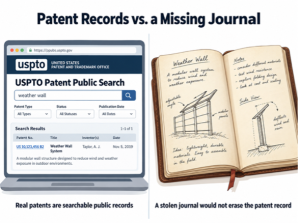
Where Disney goes too far is treating the missing document almost like the deed to the invention itself. However, a real patent does not exist only as the certificate sitting in an inventor’s desk drawer. An inventor seeking a patent submits an application to the USPTO describing the invention. A patent examiner then reviews the application and determines whether the statutory patentability requirements are met before a patent can issue.
Issued patents and published patent applications are also searchable through the USPTO’s public records. So, if Agnes had received a U.S. patent, Ebenezer could not simply pull the certificate out of her journal and erase her from history. Destroying her copy would not destroy the government’s record, change the named inventor, or make Ebenezer the inventor instead. In other words, Agnes’s journal could help prove who invented the weather walls, but stealing the journal or patent document would not erase the patent itself.
Even if recovering Agnes’s patent document would not restore any legal rights by itself, the passage of time creates another problem for the movie’s treatment of the patent. Patent rights are temporary. Although the term for the average patent generally lasts 20 years after the application’s filing date, enforceable patent rights ordinarily begin only after the patent issues. Because Agnes created the weather-wall technology generations before the events of Zootopia 2, far more than 20 years earlier, any patent rights she once held would have expired long ago. Recovering the document would therefore matter primarily for restoring Agnes’s historical credit as the inventor, not for giving her descendants new exclusive rights over the weather-wall technology.
Disney Did Well, But It Could Have Been Better!
Zootopia 2 is, of course, a movie and not a patent law lesson. Disney does not need to turn the credits into a legal treatise. And although I, as a law student interested in IP, may not be the movie’s target audience, I could not help but notice where the patent law could have been a little more accurate.
Because the story relies so heavily on a fictional patent system, Disney could make a small effort to distinguish its creative choices from actual U.S. patent law. For example, a brief note in the end credits, a short explainer on Disney’s website, or even a companion video on its YouTube channel could be helpful. These additions could clarify that a “patent of authorship” is fictional, that stealing a physical patent document would not erase the government’s patent record, and that control over an invention does not make someone its inventor.
That clarification could be especially valuable because movies often introduce legal and technical concepts to audiences who may have little prior exposure to them, including younger viewers. When a fictional rule is central to the plot, viewers may understandably assume that at least some part of it reflects how the real system works. A short disclaimer or educational feature would therefore be a relatively minor addition that could preserve the story while helping viewers distinguish Hollywood invention from actual patent law principles.
Conclusion
Zootopia 2 may take creative liberties with the patent system, but it gets one important principle right: money, influence, and control do not determine inventorship. Agnes’s story illustrates the distinction between inventing a technology and owning the rights to it, while also showing why records of the inventive process can matter when credit is disputed. The patent at the center of the story may be fictional, but its lesson about inventorship is real.

Aakash Ray
Associate Blogger
Loyola University Chicago School of Law, J.D. 2028