The Real Cameo®
Have you ever heard of Cameo? Maybe you’ve purchased a Cameo, or perhaps received one as a gift? Cameo is a digital service that allows customers to purchase customized videos from well-known celebrities, athletes, influencers and so on. For my mom’s birthday, I got her a Cameo of her favorite Irish comedian/cook—safe to say it went down in her gift hall of fame. Whatever the occasion may be, Cameo is dedicated to connecting iconic figures to everyday people in a meaningful yet accessible way. I have long admired this ingenious digital service. When I saw that Cameo was suing OpenAI for infringing its trademark, my first thought as a curious law student was—what protection can trademark law provide when an AI company copies a well-established digital service like Cameo?
The answer to that question is complicated. Here’s the short version. Trademark law protects a service’s name from being copied, not the service itself. AI companies are proving their ability to copy digital services quickly and cheaply. Trademark law cannot shield against that, but it may still offer protection for digital services in the wake of this AI revolution. When a digital service is vulnerable to AI copying, the original’s name helps distinguish the original from the AI replica. A strong trademark helps consumers to find, recognize, and trust the original digital service, helping prevent an unknowing consumer from confusing the AI replica with the original. This distinction is especially important for consumers who, for example, would prefer to purchase an authentic video recorded by a celebrity than one generated by AI. I don’t think I would have retained legendary gift giver status, had I bought my mom an AI generated video of Garron Noone.
Trademark Law Crash Course
You’ll need to learn a bit about trademarks before we go any further. Let’s go over the basics.
A trademark is any word, phrase, or symbol that is used in commerce and serves to identify the source of a good or service. Consider Cameo: a word used in association with the sale of customized celebrity videos that is meant to tell people, “We’re Cameo, and these videos come from our platform.” A trademark does its job when customers connect that name to the company behind it. How easily they draw that connection depends on how distinctive the trademark is.
Trademark law is oriented around protecting consumers from confusion within the marketplace. The purpose is for consumers to be able to easily identify, absent confusion, the source of the goods or services they choose to purchase. To do so, the law sorts trademarks along a spectrum of distinctiveness. The more distinctive the trademark is, the more protection it is afforded.
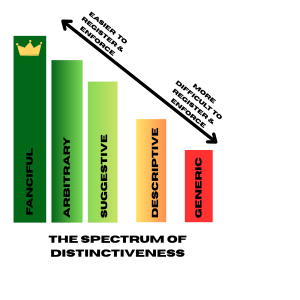
At the strong end of the spectrum sit fanciful and arbitrary trademarks. A fanciful trademark is a word that is completely made up. Think Spotify®. An arbitrary trademark is one whose use has no connection to the word itself. Consider the word adobe, defined as clay used as a building material. The trademark Adobe® for a software company, bearing no connection to the dictionary definition, is arbitrary.
Next, in the middle of the spectrum, are suggestive trademarks. A suggestive trademark hints at what a product or service is or does but takes some imagination to get there. Think Pinterest®, a trademark for an app where you can “pin” your interests. Suggestive trademarks, along with fanciful and arbitrary trademarks, are considered inherently distinctive. This means that, from the outset, the trademark itself enables consumers to connect it to its source.
Near the end of the spectrum are descriptive trademarks. Descriptive trademarks describe something about the good or service—a main feature, characteristic, purpose, or element of the good or service. Ancestry.com® is a descriptive trademark for a digital service allowing customers to trace their ancestral lineage. For a descriptive trademark to be protected under trademark law, it must have acquired distinctiveness. Acquired distinctiveness (also known as secondary meaning) is not automatic. It develops over time, as consumers come to primarily associate a descriptive term with a single source. It can be achieved through extensive marketing and advertising, consistent and long-term use in the marketplace, and other efforts to build commercial strength. Commercial strength measures how well consumers associate a trademark with a particular source. Such efforts create a connection between the good or service and its source in the minds of consumers. That connection strengthens a trademark that would otherwise lack distinctiveness.
Finally, at the end of the distinctiveness spectrum are generic terms. Words that are commonly used to describe an entire class of goods or services fall into this category. Competitors must remain free to use those common terms to describe their own goods and services, so a generic term cannot receive trademark protection for the class it names.
Cameo v. OpenAI

In September 2025, OpenAI launched its Sora 2 app. The app included a feature that allowed users to create AI-generated videos of consenting celebrities using prompts of their choosing. And what did OpenAI choose to name this familiar-sounding feature? You guessed it—“Cameo.” Open AI referred to these videos as cameos and claimed the feature was unique to Sora 2, touting it as the app’s defining feature.
To add insult to injury, some of the Sora-generated videos were practically indistinguishable from popular Cameo videos. OpenAI even recruited several of the same celebrities who serve as Cameo “talent” to appear in the AI-generated cameos. As a result, Cameo filed a lawsuit against OpenAI for trademark infringement. Trademark infringement refers to the unauthorized use of a trademark, in commerce, that is likely to cause consumer confusion as to the source of the good or service. Cameo asked the court for a preliminary injunction against OpenAI’s use of the word “cameo.” A preliminary injunction is a court order that stops a party from engaging in certain conduct while a case proceeds. Cameo argued that OpenAI’s use of the word “cameo” on similar short-form, celebrity-adjacent videos created consumer confusion.
OpenAI opposed Cameo’s claim, arguing, among other things, that Cameo’s trademark was conceptually weak because the word cameo, by definition, has a close connection to the service offered by Cameo. The strength of a trademark is one of the factors courts weigh in deciding whether consumers are likely to be confused. OpenAI argued that the conceptual weakness of Cameo’s trademark weighed against confusion regardless of how well known it was.
However, the conceptual strength of a trademark is only part of the inquiry into the overall strength of a trademark. Conceptual strength asks where the trademark falls on the distinctiveness spectrum. Commercial strength asks whether the trademark has gained enough marketplace recognition to be remembered and associated with its source. A conceptually weak trademark can be strengthened by a showing that it is commercially strong.
The court agreed with OpenAI that the Cameo trademark is conceptually weak, falling between suggestive and descriptive on the distinctiveness spectrum. But there was a saving grace for Cameo—its commercial strength. Cameo effectively showed that even if its trademark was conceptually weak, its proven commercial strength made the trademark strong. First, they highlighted that Cameo has been featured in thousands of media articles and reports—from Forbes to The New York Times. Additionally, they showed that Cameo social media accounts have amassed millions of followers and racked up over 100 million views in the prior year alone. Finally, they noted that Cameo is frequently credited on hit late-night talk shows—SNL and The Daily Show, to name a few. The court found that these indicators of commercial strength outweighed the trademark’s conceptual weakness.
Ultimately, the court granted a preliminary injunction, temporarily barring OpenAI from using “cameo” as the name of its Sora feature. OpenAI initially appealed this ruling. Soon after, OpenAI dropped the appeal after discontinuing its Sora feature in April 2026, ultimately ending the dispute. Whatever prompted that decision, the outcome shows how commercial strength can help a conceptually weak trademark receive protection.
Finding an Edge Over AI
It’s difficult to imagine the years of planning, creative thinking, and trial and error that went into building a digital service as unique and popular as Cameo, just for it to be copied with ease by a powerhouse AI company. If AI had legs, it would certainly have a leg up in the digital service industry. AI can build competing services more quickly and cheaply than ever before. Its ability to synthesize massive data sets, rapid development speed, and low production costs give it an edge that feels almost impossible to compete with. Digital services that companies spent years and significant resources building can now be replicated by AI in a fraction of the time and for pennies on their dollar.
The realities of AI’s advantages do not and should not serve as a death sentence to companies and brands dedicated to developing new and useful digital services. If anything, the rise of AI requires adaptation and strategic planning that only we humans can conjure up.
Strategic trademark practice is a promising place to start. For newcomers looking to establish a trademark for their digital services, aim high on the distinctiveness spectrum. Be strategic with your word choice, using fanciful and arbitrary terms when possible. Weigh the consequences of choosing a word that falls lower on the distinctiveness spectrum. Because Cameo’s trademark was considered conceptually weak, its overall strength depended on proving its commercial strength. Cameo was able to prove the overall strength of the trademark through its extensive media coverage, large following, and millions of views across social media. But having a more distinctive trademark establishes trademark strength prior to the consideration of commercial strength. Even if an AI company copies the idea behind your service without infringing your trademark, a strong, highly distinctive trademark helps customers find, recognize, and remember the original.
For established trademark owners and newcomers alike, focus on increasing your trademark’s commercial strength. Leverage advertising, marketing, publicity, and social media presence to strengthen your trademark. The Cameo court noted the business structure of Cameo as being driven by talent promotion across social media, extensive media coverage, and customer sharing—“every Cameo is a commercial for the next one.” Cameo’s commercial strength may seem unattainable to newer digital service companies, but they, too, had to start somewhere. Word of mouth and social media presence are accessible ways to begin building commercial strength. Building commercial strength around your trademark creates the association between your trademark and your company in the minds of consumers. These efforts are a strategic way to strengthen your trademark and may afford protection to a trademark that falls lower on the distinctiveness spectrum (i.e., a descriptive mark).
When They Go Low, You Go High (on the Distinctiveness Spectrum)
Trademark strategy may seem like a drop in the bucket in the face of rapid AI development. Yet it is one of the most practical ways to maintain an edge over AI replicas of digital services. In an era when AI can replicate digital services with ease, the name that sticks in the minds of consumers is what can set the original apart. Trademark law can’t protect the service itself, but a distinctive, well-protected mark helps customers find, recognize, and trust the original. So roll up your sleeves and get creative, strategic, and high on the distinctiveness spectrum.

Mimi Vanek
Associate Blogger
Loyola University Chicago School of Law, J.D. 2028