
When I read my first invention disclosure, an inventor’s confidential technical report describing a new invention, I believed I was conducting technical due diligence. After all, I was an engineering intern. I didn’t think I would be studying any legal doctrine. Well, it turned out I was doing both.
The job was simple. Evaluate novelty. Functionality. Real-world value. Looking back now, I see that I was not only working with intellectual property (IP) but also developing arguably the most important skill used in the field of patents:patentability evaluation. Although I didn’t have the language to describe it at the time, Loyola has helped me learn it.
Feeling Lost (and Finding a New Direction)
During my second year of undergrad, I felt increasingly disconnected from the path I was on. I was doing well in my chemical engineering coursework. But, I could not picture myself staying in a purely technical role long term. The further I progressed, the more I felt I was moving away from the parts of engineering I actually enjoyed. I missed higher-level problem solving. I wanted to communicate more. I craved big-picture thinking.
Instead of only talking with classmates that were headed toward traditional engineering jobs, I broadened the conversation. I spoke with career advisors. Met with alumni. Reconnected with friends working in adjacent fields. That is when patent law first entered the picture.
It was the perfect fit for me. It pulled together the technical foundation I had already built with business strategy, writing, and advocacy. The idea of law school was daunting. However, it was the first time in a while that my path forward aligned with my true interests. My future was no longer dictated by my educational momentum.
Learning IP without the Label
Once I knew I was interested in IP, I looked for any opportunity that would expose me to the field. This search led me to my university’s Tech Transfer Office where I was hired as an Engineering Commercialization Intern.
My job was to evaluate inventions created by university researchers and professors. This evaluation helped determine which were worth seeking patent protection. Certain areas of science, however, were abnormally complicated. Invention disclosures related to the upcycling of plastic waste was one of them. There were countless methods for this. Countless end products. Countless applications. A full evaluation for just one of these variations was already complicated, let alone each and every one of them.
I worked closely with the inventors to dissect every detail of the processes. This really opened my eyes to the legal framework behind IP protection and commercialization. I learned about “novelty” – the requirement that an invention is not patentable if it is already known to the public. I also discovered that novelty was much more than a synonym for “new.” It was dynamic. Ever changing with every industry and application. Most importantly, it opened my eyes to how even technologies in well-known fields could be patented. A variation on a common chemical process like pyrolysis, for example, could become patentable by simply tweaking the method or the catalysts used.
I also took an Introduction to Brewing class with one of my engineering professors. We started with a base formula and tweaked it to create something distinctly our own. The process paralleled my work in the tech transfer office. There, I had to identify what was truly new in someone else’s invention disclosure. In brewing, I got to create that novelty myself. I even got to explore alternate variations further in an honors assignment at the end of the course. After bottling, we named our beer and built an entire brand around it. We even designed a logo. That process paralleled the commercialization aspect of tech transfer. It also opened my eyes to trademarks and marketing. I found myself naturally applying many of the same early-stage commercialization steps I had learned in my tech transfer role.
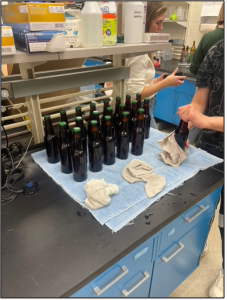
At the time, I viewed these as purely applied engineering roles. Only later did I realize that I was learning about IP and working directly with not only potential patents, but also trademarks and copyrights.
Choosing Loyola
When it came time to apply to law school, I focused heavily on Chicago and began researching IP programs in the area. Loyola quickly stood out, not just for the breadth of its IP program, but for how intentional and accessible the IP community seemed.
I reached out to students and professors, including Professor Ho (the director of Loyola’s IP program), to better understand what studying IP at Loyola actually looked like. After a quick exchange, I was invited to attend Loyola’s annual IP reception. That was the first time I got to see how tight knit the community was.
My conversation with now 2L Addie Schmidt deepened my understanding of how central IP is across industries like pharmaceuticals, manufacturing, consumer products, and even software. Especially for engineers moving into law. While my work in the tech transfer office and even the brewing class introduced me to patents and commercialization, our discussion helped me see the bigger strategic picture. We talked about how companies use IP not just to protect inventions, but to attract investment, structure partnerships, and compete globally. That conversation didn’t introduce me to IP for the first time, but it reframed it. Most importantly, it showed me that IP was not abstract or niche. It was practical, strategic, and everywhere.
With each interaction, I gained confidence that I belonged in this space. Even before my first day of classes, Loyola was setting me up for success.
From Technical to Legal – and Everything in Between
Now at Loyola, that sense of clarity has only grown stronger. My career advisor Jennifer Lazarus helped me reshape my resume to reflect my IP interests and recognize that much of my prior work already counted as relevant IP experience.
Now in my second semester, I am taking Professor Cynthia Ho’s elective course “Global Access to Medicine: A Patent Perspective.” It has been one of the most unique classes I’ve taken so far, and it has genuinely reshaped how I think about patents. The course introduced me to new patent concepts and policy frameworks, like TRIPS. Over the course of this semester, we have learned how the TRIPS agreement has implicated patent laws in the US and less developed countries. This is accomplished by establishing a mandatory minimum standard for IP protection that each WTO member state must comply with. I’ve already been able to put those ideas into practice by working with classmates to read and discuss current articles on patent policy. The experience has helped me translate complex IP issues into clear, real-world conversations.
That course, along with my IP-focused legal writing, has given me practical tools and professional talking points that directly translate to interviews and networking. Outside the classroom, Loyola’s IP Law Society has made it easy to connect with employers and upper-level students who are generous with advice and perspective. Being surrounded by other IP-interested students has reinforced that this field is collaborative, dynamic, and far more accessible than I once thought.
The Bigger Takeaway
When I first moved to Chicago, I was nervous about starting over in a new city surrounded by people I didn’t know. But my time at Loyola, and the incredibly welcoming community here, has made that transition far easier than I expected. Through school, networking events, and organizations like IPLAC and LAGBAC, my world has expanded well beyond campus. I’ve come to genuinely enjoy building relationships with my peers and the broader legal community around the city.
One of the most valuable lessons Loyola has taught me is that IP does not start in law school. It starts much earlier, often before you even know what to call it.
If you are a prospective student interested in IP, especially with a technical or industry background, Loyola excels at helping you recognize and build on what you already bring to the table. For me, Loyola did not create my interest in IP, it helped me realize I had been engaging with it all along.
And that realization has made all the difference.