

I came to Loyola University Chicago School of Law thinking I had my path mapped out. I graduated from the University of Michigan with a degree in Biopsychology, Cognition & Neuroscience and had experience working in healthcare. Because of this background, health law felt like the natural fit. Loyola’s Health Law program is also ranked fourth in the nation, which made the decision even more intuitive. At the time, intellectual property (“IP”) felt abstract, a field reserved for people who already “knew the language.” However, I quickly found out I was wrong.
During Loyola’s JD Admit Series: Mock Class with Professor Cynthia Ho, I was introduced to IP law in a way that felt practical and exciting. Without getting into the technical details, we talked about familiar brands and statutes that protect them including McDonald’s golden arches and the Starbucks logo. During the session, we talked about the Lanham Act – the federal trademark statute. This statute allows businesses to apply for federal trademark protection for their brand names, logos, and other identifying marks. By the end of that session, IP had gone from an afterthought to a genuine curiosity. The early exposure via Professor Ho’s mock class made all the difference as an incoming student.
The Moment IP Clicked
Professor Ho didn’t just explain what IP is. She showed how it works. We walked through a little bit of trademark law by unpacking why Apple can be an “arbitrary” trademark for the company that makes popular phones and computers, while aspirin became “generic.” IP didn’t feel theoretical anymore. It instead felt like it was all around me.
What stuck with me most was a deceptively simple question. As an business owner, are you looking to against confusion in the marketplace or against anyone making your invention? That contrast between trademark and patent law reframed IP as a strategic choice, not just a technical one. For a student coming from a neuroscience and health background, it felt like discovering a completely new legal space. I saw where science, innovation, and real-world impact could all intersect.
IP Without Experience at Loyola
Once I started my 1L year, I realized something important. Even if you aren’t enrolled in an IP-specific class yet, IP is everywhere at Loyola.
At the Student Activities Fair, I met a 2L named JT Burns who encouraged me to explore IP more. That conversation set off a chain reaction. I applied to become a 1L Representative for the Intellectual Property Law Society (IPLS). The role let me assist with event planning, marketing, and outreach. More importantly, the position gave me a front-row seat to the IP community.
Through IPLS, I attended every event I could: firm mixers like Marshall Gerstein’s, panels, lunch-and-learns like K&L Gates’, and alumni networking sessions with professionals like Krista Solano, Daniel Henry, and Hillary Maynard. I met attorneys practicing across IP litigation and patent prosecution and learned what the patent bar actually entails, including that I am eligible to sit for the patent bar and practice before the USPTO based on my undergraduate degree.
I also began to understand how different firms structure their IP practices. For example, some firms separate patent prosecution and litigation into different practice groups, while others integrate them within broader IP teams.
What surprised me most was how accessible everyone was. You didn’t need prior IP experience to engage with folks in the IP space, just curiosity and a willingness to ask thoughtful questions.
Loyola upperclassmen were consistently generous with their time, advice, and honesty. Everyone I reached out to was willing to meet, review materials, or connect me with someone else who could help. They remembered what it felt like to be new, overwhelmed, and unsure. They paid it forward. 2Ls and 3Ls can tell you which events were worthwhile, how to approach networking, and how to explore IP without committing too early.

Mentorship as a Bridge
Through the Leadership Council on Legal Diversity (LCSD) and the Diversity Scholarship Foundation (DSF), I also connected with two mentors. These professionals have reshaped how I think about community in this profession.
With Gabrielle Sue from Marshall Gerstein, I found someone who invested in my future alongside me. When she didn’t have the exact answer to navigating externship applications, she would go out of her way to gather insight by reaching out to colleagues who did. She followed up unprompted and encouraged me to network even more. Ultimately, what stood out to me the most was that she treated my development as something worth her time.
Similarly, Edgar Matias from Riley, Safer, Holmes, & Cancilla became someone I could relate to on a different level. He understood the emotional toll of 1L including the uncertainty and pressure. Even when I felt hesitant to reach out without a polished update, Edgar would check in anyway. That reassurance ended up meaning more than any strategic career advice.
Over the course of one semester, I connected and stayed in touch with over 50 IP professionals. These were genuine discussions about career paths, practice differences, and how to leverage a technical background in law. Through these relationships, I noticed the IP community was there to support me long before I had credentials or experience to offer in return.

The Road Ahead
When I first applied to Loyola, I thought my neuroscience background would lead me exclusively towards health law. Now, I see something broader. I’m beginning to understand how intellectual property shapes innovation. Patents influence access to medicine. Trademarks protect emerging biotechnology companies. Legal strategy affects which ideas come to commercial fruition.
What intrigues me most is the intersection between science and the legal system. These two worlds shape who gets to innovate, how discoveries are protected, and how those benefits reach the public. Moving forward, I plan to deepen my understanding of patent law. I primarily want to do this by taking more IP-focused courses, continuning to attend IPLS events, and by sitting for the patent bar. I’m eager to explore how my scientific training can inform the life sciences space. I look forward to growing alongside my mentors and sharpening the technical skills I first discovered in Professor Ho’s mock class. I’m leaning into the curiosity that led me here.
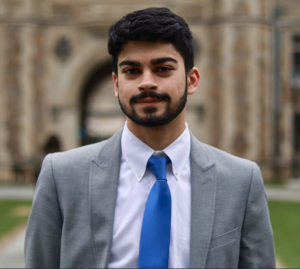
Aakash Ray
Assistant Blogger
Loyola University Chicago School of Law, J.D. 2028