
Some scholars are calling 2026 the “year of the moon.” Why? NASA, for the first time since the Apollo missions of the late 1960s and early 70s, sent astronauts to orbit the moon. But NASA is not alone. Joining the moon party this year are the Chinese, who are sending a lunar robot to study the moon’s south pole. Private companies like Blue Origin, Firefly, SpaceX, and more are also gearing up for moon missions this year. It would seem we have entered a modern-day space race. Innovation and ingenuity help drive space exploration and are critical to further our understanding of outer space. So how do intellectual property laws, which help drive innovation on Earth, apply…up there? Do laws even exist in space?
Yes, we went to the Moon…Again!
On April 10, four NASA astronauts splashed down safely in the Pacific Ocean, ending their 10-day trip around the moon. The goal of this year’s mission, called “Artemis II,” was to conduct a “lunar flyby” and test NASA’s Orion spacecraft with the hope of sending astronauts to the lunar surface as soon as 2028. As mentioned above, the China National Space Administration is also sending a lunar robot to the moon this year to study its south pole. Its goal: work with Russia and other countries to develop a lunar south pole research station. Space and lunar exploration are becoming increasingly relevant once again. So it begs the question: intellectual property laws certainly have a role on Earth, but do they in space?

How are Patents Relevant to Space?
Patents are the most important type of intellectual property for space because, as I explain below, they are essential to technological innovation. A patent is a government-issued document conferring the sole right for a patent owner to exclude others from making, using, or selling their invention. In the U.S., to have a patent, the invention must be new, useful, and nonobvious.
There is a strong policy incentive behind these criteria. Patents are exclusive. We don’t want to grant inventors strong exclusivity rights for creating something that isn’t new or would be obvious to discover. Or give rights for something that isn’t useful. The main idea is to encourage future inventors to build upon the patent to create something new, so they, too, can patent things that help society. And so on and so forth.
This is why patents may be the most important intellectual property right for space exploration. In simple terms, to explore new things in space, you must invent new stuff. For example, components of NASA’s Artemis II spacecraft, Orion, are patented such as an advanced docking mechanism. Furthering space exploration hinges on scientific and engineering advancements and discovery.
But how do patents impact those beyond just the patent owner? Importantly, patents are publicly disclosed. So, while the public will know how to create and use the invention on the day the patent issues, they are still prohibited by law from doing so. If someone manufactures, uses, sells, or imports an already patented invention without permission, they could be liable for patent infringement during the term of the patent (around 20 years). Someone infringes a patent only if infringement occurs in the country where the patent is in effect. For example, say someone makes a U.S.-patented item in Australia. It does not infringe in Australia if there is no Australian patent. However, to combat this, many large companies will patent their inventions in numerous countries to gain as much protection as possible.
So, patents are relevant to space. But what’s the problem?
The Space Patent Process (or lack thereof)
Because patent laws differ across the world, there is no “uniform” law to apply in space. Remember, to sue for patent infringement, the infringing activity must occur in the country where the patent exists. There is no singular “international” patent law practiced by countries worldwide. Individual countries have their own sets of patent laws. They may look similar or completely different than others. That’s the problem.
The world can’t just choose one country’s patent law and apply it to outer space. It would be unfair. And, obviously, no one would agree on one. So, countries would have to create a new uniform law. Believe it or not, a form of space law already exists. It just doesn’t involve patents.
The Outer Space Treaty
The Outer Space Treaty was adopted by the United Nations in 1967 to promote peace and harmony in space. In other words, to prevent the United States and Soviet Union from using nuclear weapons there. Since then, more than 115 countries are parties to the treaty, which declares that all things in Outer Space are “things common to all.” Thus, each country is responsible for its actions in space and is precluded from claiming sovereignty over celestial bodies. For example, the United States can’t claim the moon. But the country where a spacecraft (anything launched into space, including ships and satellites) is launched retains registration, control, and responsibility for that spacecraft.
The Flags of Convenience Loophole
Any government agency or private company wishing to launch a spacecraft must register it with the country from which it is launched. For example, NASA registered the Orion spacecraft with the U.S. because it launched from Cape Canaveral, Florida. For its part, the launch country (the U.S. in this example) must maintain a register of all objects it launches into space because it must, in turn, report all launches to the United Nations Office for Outer Space Affairs to keep track of everything up there.

Once in space, the spacecraft is subject to the laws of the country that registered and launched it. This includes the country’s patent laws. A useful analogy is Earth’s oceans, which function a bit like space. The ocean, too, is “a thing common for all.” A ship on the high seas operates under the law of the country from which it is registered. Spacecraft operate in much the same way.
But herein lies the problem. To reduce operating costs or avoid certain laws on the high seas, ship owners regularly register their vessels in different countries. This practice is called “flags of convenience.” The idea is that registering a vessel in a particular country or under a particular flag may be cheaper and easier than doing so in other countries. The ship is subject to the laws of the registering country, regardless of whether it is actually affiliated with that country.
Well, now take maritime law, apply it to space law, and factor in patents. For example, say NASA wants to use a new rocket booster for its Orion spacecraft designed by Elon Musk. But Musk patented the booster only in the U.S. Under the flags of convenience theory, NASA could manufacture the booster in another country and register and launch from that country without being sued by Musk for patent infringement. There’s the loophole. In this example, Musk would be powerless to protect his invention under U.S. law. Because he only patented in the U.S., he would be powerless under any law, anywhere else.
One Small Step for Man, One Giant Leap for Patent Law
U.S. law permits a patent holder to sue for patent infringement in space only if the infringing product was registered and launched from within the U.S. The same narrow mechanism is likely enumerated in other countries’ patent laws as well. Yes, some large companies have the money and resources to patent in multiple countries to avoid this issue. But that solution is akin to putting a really expensive bandage over the hole of a sinking ship. It may work for those who can afford it, but it does nothing to fix the underlying problem. And for most, it remains a long, costly, and cumbersome process. Instead, we should fix the root of the issue to better streamline the patent process for everyone. I can think of two ways to resolve this.
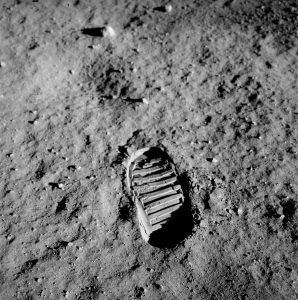
First, countries, perhaps some of whom are parties to the Outer Space Treaty, can create a new, uniform patent law for outer space by ratification of a new patent treaty or by amending the Outer Space Treaty to create a uniform law. Under either mechanism, space could be defined as its own “country.” Anything, from anywhere, launched into space would be subject to this uniform law. Using the Musk example from above, he could sue for infringement if his U.S.-patented invention was made or used in space, regardless of where it was launched. A Global Space Patent Court could be established, similar to the Unified Patent Court in Europe, to provide a venue for such suits.
Second, participating countries could alternatively establish an outer space patent registry under an international treaty. It would function like the United States Patent and Trademark Office (USPTO) (the government office responsible for granting patents in the U.S.) or any other domestic patent office worldwide. But this registry would be accessible to individuals from countries worldwide. If an inventor were to patent something under this system, it would always grant the patent holder the right to enforce the patent, regardless of where the infringing product is launched from, as long as the infringement occurs in space. Of course, the participating countries would need to agree on the same patent standards. But, as the need for a uniform law grows, I believe this is doable. Both options would close the flags of convenience loophole.
These suggested solutions will amount to nothing if countries cannot come together to create a uniform patent law for space, designed for the greater good. That means setting aside differences to put innovation and humanity first. The United States, the United Kingdom, and the Soviet Union developed the Outer Space Treaty during the Cold War. If it was possible back then to get those polarizing countries to sit at a table and sign a treaty, it’s possible now.
We’re entering the year of the moon. We’re also seeing rapid development in the commercial space industry. Outer space arguably hasn’t been this relevant since the 70’s. It certainly hasn’t been this crowded. Space law needs an overhaul before exploration gets out of hand. It starts with patents.

Michael Bahu
Associate Blogger
Loyola University Chicago School of Law, J.D. 2027