
As someone who has little to no interest in football, let alone the Super Bowl, I still tune in every year just for the commercials. With a background in advertising, the moment the game goes to a commercial break, my TV comes off mute! This year, one ad in particular really caught my attention, Pepsi’s Super Bowl commercial, “The Choice.”
The commercial opens with a Pepsi can, a polar bear, and Coca-Cola’s iconic, well-known can, displaying the company’s trademarked name (i.e., “Coca-Cola”). A trademark is a word, phrase, design, or combination that identifies and distinguishes a good or service from others.
The polar bear then performs a blind taste test between Coke and Pepsi. The clip features a Coca-Cola can alongside a Pepsi can. The polar bear takes a sip and confidently believes he has chosen Coke, but when the bear’s blindfold is removed, he discovers he not only chose Pepsi, but preferred it. The commercial continues to follow the bear as he grapples with his unexpected revelation. Coke and Pepsi have long been rivals, often referencing each other. However, the clear feature of Coca-Cola’s can got me thinking: how can Pepsi use its competitor’s trademarked assets in a national commercial without running into liability for trademark infringement?

The answer to this question comes from trademark law defenses that apply to comparative advertising, among other contexts. Particularly, how the doctrine of nominative fair use allows companies to reference competitors’ products when necessary to help consumers compare them. In addition to being a defense against infringement liability, nominative fair use is a way to use another’s trademark fairly from the get-go! Keep reading to learn how nominative fair use allows for legal comparative advertising.
A Little, Legal Friendly Rivalry
Before diving into the legal doctrine, let’s briefly define comparative advertising. Comparative advertising is when a company directly compares its product to a competitor’s. Typically, this is done to show why its product (or version of the product) is the better choice. Bold, comparative advertising is not prohibited by law. Actually, U.S. regulators encourage truthful comparative advertising as a means of providing consumers with useful information to make informed decisions.
However, making these comparisons often requires direct reference to competitors. Which, in turn, typically means using another company’s trademark. Here is where trademark law inevitably comes into play.
With respect to the Pepsi commercial, beyond the Coca-Cola word trademark, the cola-can raises the question of trade dress. Trade dress, a subset of trademarks, can include the overall visual appearance of a product, including its design and color. An example of trade dress is Coca-Cola’s contour glass bottle, which is a registered trade dress, meaning that the US Patent and Trademark Office found it to be valid. When it comes to the aluminum can, the bold red background could also be considered trade dress if it has acquired secondary meaning (i.e., consumers only associate this red color with the brand Coke). Coca-Cola has not formally registered the can in its entirety as a trademark or trade dress, but it may still have trademark/trade dress protections, as trademarks do not require registration to be valid and enforceable. So, this red-colored can could be a trade dress.

Is the polar bear a trademark for Coca-Cola? It is unclear. The polar bear that is seen in the commercial is a long-standing brand mascot used in Coca-Cola’s advertising. Unlike the word mark on the can, the bear is not a registered trademark. But, as mentioned earlier, it could still have trademark rights if used in commerce to identify a good or service. As it is not certain that the bear is used in connection with Coke products (or even regularly placed on products) to identify Coke, the polar bear does not have clear trademark protection. For this blog, we will focus solely on the iconic “Coca-Cola” trademark as used in Pepsi’s commercial.
So, which legal principle permits companies to reference a competitor’s trademark? The answer brings us to nominative fair use.

Name-Dropping under Nominative Fair Use
Nominative fair use is a doctrine under trademark law that allows a company to use another company’s trademark when certain criteria are met. The catch is that, for the use to fall within the nominative fair use exception, its use must be necessary to identify the other company, product, or service. Put another way, companies traditionally use trademarks to identify their own products, while nominative fair use allows a company to use a trademark to identify the origin of a product different from their own. For example, a third-party phone case seller is likely to market a case with the trademark “Apple iPhone” to let customers know the case is compatible with Apple iPhones.
Determining whether nominative fair use applies involves a framework developed by courts. In general, there are three factors to consider which all must be satisfied for nominative fair use to apply.
The first factor asks whether the product could be identified without the use of the trademark. Some products are so visually similar that without a brand name or logo, consumers would not be able to tell them apart. For example, think of two jars of pickles sitting side by side, without any branding; they both have the same clear jar shape, so you know they are pickles. However, without signals such as the brand name and logo, no one would be able to tell which jar of pickles belongs to which brand.
The second factor asks if only as much of the mark as reasonably necessary to actually identify the product was used. Typically, under nominative fair use, the use of another’s trademarked logo is seen as excessive. Using the phone case example, the phrase “Apple iPhone 14” may fairly be used to show compatibility. However, that doesn’t mean the case seller could use the Apple logo on its packaging. The phone’s name is enough to identify the product. Anything more would be deemed too much, and nominative fair use would not be applicable.
The third and final factor asks whether the use implies that the trademark owner sponsored or endorsed the use of their trademark, OR, in some jurisdictions, if the affiliation is clear from the language or conduct. In evaluating improper sponsorship or endorsement, the issue is that a competitor can’t use another’s trademark in a way that may lead consumers to believe the other brand was involved. In evaluating clear affiliation, an explicit disclaimer stating the trademark owner has no affiliation with the ad easily satisfies this factor.
Comparative advertising is not the only area in which nominative fair use plays an important role. As mentioned before, referencing another’s trademark may be necessary to describe product compatibility (as in the iPhone example). In the iPhone example, the trademark is not used to indicate the source of the phone case, but to identify the trademark owner’s product.
Putting Pepsi on the Stand
Now, let’s apply the nominative fair use factors to the use of the Coke can, and its clear display of Coca-Cola’s registered word mark.
Looking at the first factor, the commercial references the Coca-Cola can to make a direct comparison between the two products. The context of a blind taste test between Pepsi and Coke would be rather difficult, if not impossible, to convey to the audience without identifying the mark (Coca-Cola can). Both are bubbly, brown sodas in an aluminum can shape, and viewers have only what they can see in the commercial to go by. The use of the trademark can help viewers immediately identify the products being compared. Additionally, the commercial’s 45-second length means consumers need to get the gist right away to follow the rest of the advertisement. Since there is arguably no other way to identify Coke in a blind taste test, factor one is satisfied.
The second factor is more nuanced. The commercial uses the red Coke can with a prominent display of the wordmark “Coca-Cola.” The can’s wordmark tells viewers exactly which product Pepsi is being compared to. But could Pepsi have used even less to identify Coke, like a plain red can? Would consumers immediately associate a red can with Coke? Given that there are other red cans on the marketplace, although different shades of red, (e.g., Mountain Dew Code Red, Big Red soda, and Dr. Pepper), Pepsi probably was safe to include Coke’s word mark. More importantly, Pepsi used the can as it is found in the marketplace, where the word mark appears on the can. Using the can as consumers recognize it is arguably a reasonable application of what is necessary. Since it’s a 45-second commercial, a quicker association helps consumers follow. Ultimately, Pepsi did not take too much. They did not enlarge the Coca-Cola logo separately or use it in a way inconsistent with Coke’s commercial impression. Therefore, the commercial can be seen to use only what is reasonably necessary to identify Coke, satisfying factor two.
Third and final, the commercial has nothing that suggests Coca-Cola sponsored, approved, or endorsed the advertisement. In jurisdictions that also consider whether the relationship between the brands is clear, the commercial also satisfies that standard. The entire premise of a blind taste test in which a polar bear chooses Pepsi makes the competitive, non-affiliated relationship between the brands immediately obvious. The competitive nature of the commercial and the act of a blind taste test make it relatively clear that the entire premise of the commercial depends on the brands’ rivalry.
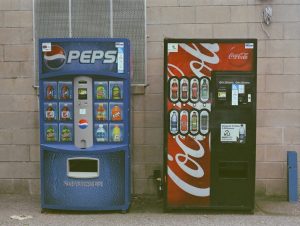
So did Pepsi take it too far?
While nominative fair use typically permits comparative advertising, there are limits. Comparative advertisements can fall outside the scope and cross legal boundaries. As previously mentioned, nominative fair use fails if one of the factors is not met. If the Pepsi commercial had included Coke’s script logo not just on the can but throughout the commercial on merchandise, props, or just across the screen, it would start to look less like reasonable identification and more like trademark infringement. Therefore, nominative fair use would not be a defense. If this had been the case, not only would Pepsi have used more than necessary (failing factor two), but it would also arguably suggest that Coca-Cola endorsed or collaborated on the commercial (failing factor three).
That’s not what happened here. The Coke can, which includes Coke’s formally registered trademark of Coca-Cola that appears in the commercial, is used only in the context of the blind taste test. This is needed to identify competing cola sodas. Nothing in the commercial suggests Coca-Cola was involved. In fact, the commercial’s humorous tone and story suggest competition rather than endorsement. Based on the three-factor framework applied to the Coke can, the commercial falls within nominative fair use.
The Polar Bear’s Final Verdict
Pepsi’s Super Bowl commercial is a great demonstration of how advertising strategies and trademark law intersect. At first view, it makes sense to question whether Pepsi can really use the Coca-Cola can. But the Coke can fit within the fair use doctrine.
Ultimately, trademark law isn’t just about protection; it also allows meaningful, healthy competition among brands! Nominative fair use under trademark law recognizes that sometimes you can’t really compare products without calling the competitor out by name! When done without causing confusion, implying endorsement, or going too far in using competitors’ marks, comparative advertising has a comfortable home within trademark law.
While the polar bear may be rethinking its brand loyalty, Pepsi’s commercial fits right in.

Isa Diaz
Associate Blogger
Loyola University Chicago School of Law, J.D. 2027