Technology evolves at the speed of light these days. Tech giants such as Google and OpenAI work to perfect their products for consumer usage, but power also lies in the name of these products. To explain, let’s look at two well-known names, Google and ChatGPT, to consider the trademark implications.
Trademarks 101
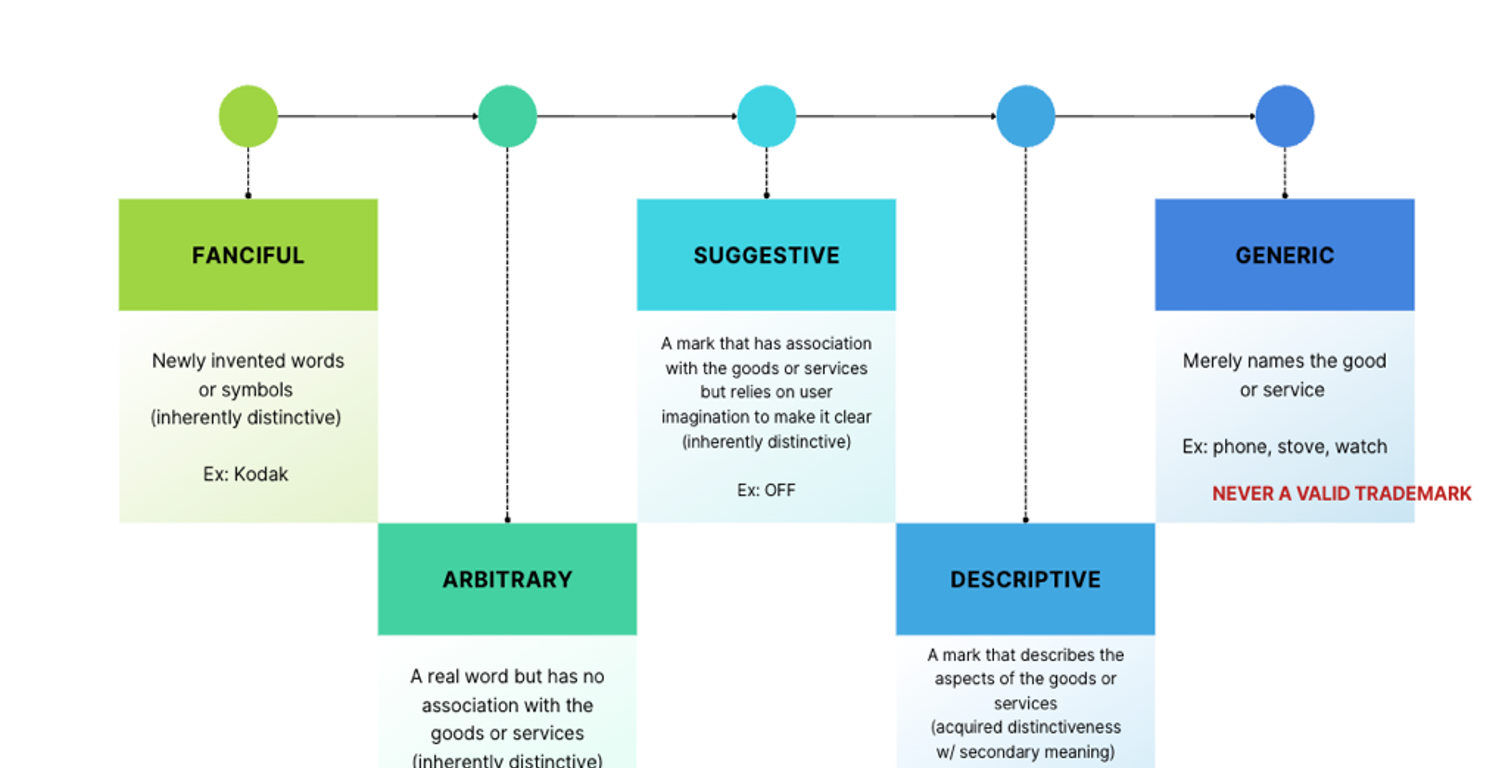
First, what is a trademark? A trademark is a word, symbol (logo), or device (or combination of these) on goods or services used in commerce that identifies the specific source of those goods or services. Not every word or symbol can serve as a valid trademark. A trademark is valid only when it is distinctive, meaning it can be readily identified in the marketplace by consumers to identify one source. Trademark distinctiveness for word marks is measured on a spectrum consisting of five categories: generic, descriptive, suggestive, arbitrary, and fanciful.
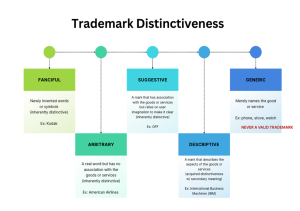 Graphic created by Kendall Henry.
Where a trademark falls on the spectrum becomes useful in both determining its strength as a valid mark and for litigation against competitors for likelihood of confusion analysis, the test for trademark infringement. On the far left of the spectrum are fanciful trademarks, which are made up words. Fanciful marks (e.g., Lululemon) are inherently distinctive, since they are unique, entirely made up words making it easy to identify its source. Arbitrary (e.g., Apple) and suggestive (e.g., Burger King) marks are also categories that are deemed inherently distinctive.
The right side of the spectrum is a bit less fortunate, since these marks are given weaker protection. Descriptive trademarks (e.g., Whole Foods) describe an aspect of the good or service and are not inherently distinctive. Instead, they must acquire distinctiveness via secondary meaning (more to follow). Moreover, generic marks can never be a valid trademark and receive protection because they merely name the good or service. This means anyone, including competitors, can use the word freely. An example of a generic mark is escalator. Can you believe it? Escalator was once a trademark of Otis Elevator Company’s moving staircase. Over time, people began to use the term escalator to describe all moving staircases and not just Otis’. Therefore, escalator lost its distinctiveness and became generic.
Registering a trademark with the United States Patent and Trademark Office (USPTO), while not required, affords trademark owners many benefits such as presumption of validity and usage of the federal trademark registration symbol ® (which can help with deterrence). These benefits are highly advantageous for anyone in the marketplace but especially for large corporations, such as Google and OpenAI, who offer highly used services that other companies may want to piggyback off of.
Registration alone nor an inherently distinctive mark ensures a company long lasting protections nor success. However, trademark strength plays an important in role in how a tech company can enforce its rights and defend brand identity over time. Basically, the more distinctive and therefore the stronger the mark, the wider the protections. For tech companies who operate in a constant race to innovation, brand distinctiveness assists in consumer recognition and loyalty.
Google®: The Power of a Fanciful Mark
Google owns a variety of trade and service marks related to many industries. Importantly, the mark “Google” for the search engine service has been a registered mark since 2004. The name “Google” originates from the mathematical expression, googol, the term for the number 1 followed by 100 zeroes. Obviously, Google as a search engine is not a math tool, nor is the spelling of such a real word. As a result, Google falls into the fanciful category of trademarks, made up words with no prior meaning in the marketplace.
As shown in the graphic above, fanciful trademarks are inherently distinctive and eligible for trademark protection once used in commerce. Unlike descriptive marks, they do not need to acquire distinctiveness over time through consumer recognition.
Also, fanciful marks are given the most protection. After all, they are made up, wholly original word marks. This makes a fanciful mark highly appealing for fast-scaling technology companies. It ultimately allows companies like Google to enjoy nationwide enforcement power (trademark infringement suits, cease & desist letters, etc.) against anyone using their mark in a confusingly similar way that misleads as to the source or affiliation, the standard for trademark infringement. This protection helped Google preserve its identity while it progressively became the most used and reliable search engine.
However, heavy is the head that wears the crown, because Google’s fame and widespread recognition introduced a different risk: genericide. Google has become a piece of normal speak. Over the years, consumers have used phrases such as “google it” to refer to the action of using any search engine, rather than just searching on the Google search engine. This phrasing deviates from the usage of the mark as a source identifier, because a consumer no longer uses it to identify who provides the service.
In Elliot v. Google, Inc., the genericness of Google’s mark was put to the test. The plaintiff in this case argued Google’s mark had become generic. However, the Ninth Circuit rejected this claim and used the “who-are-you/what-are-you” test. This states that if the public is aware that the mark is describing “who” a specific good or service or where it comes from, then the mark is valid, but if the public uses the mark as a description of “what” the good or service is, then the mark is generic. Simply put, the court held that consumers still understood Google as a specific source of search services. Therefore, the mark survived.
Regardless, the danger of genericide has not been permanently evaded, as anytime consumers use Google as a common name for any search engine, the risk increases. In the past, Xerox advertised to consumers how to properly use the mark to try to avoid genericide. This may be a next step for Google to continue anti-genericide. For now, Google remains a fanciful and distinctive mark in the marketplace.
ChatGPT: The Challenge of a Descriptive Mark
On the other hand, OpenAI, owner of ChatGPT software, has not had such glory in the realm of trademarks. “ChatGPT” was recently denied trademark registration on the grounds that it was merely descriptive. Let’s start off with the origin of the name. Unlike the fanciful nature of Google, ChatGPT is very literal. “GPT” is an acronym for general pre-trained transformer, a form of large language models (LLMs), the very foundation of ChatGPT. Further, “Chat” refers to the user’s function with the GPT. When you put the two together, it is simply describing the aspect of the artificial intelligence service, placing it in the less strong “descriptive” trademark category.
Descriptive trademarks lack inherent distinctiveness making it a much weaker category. Instead, they must acquire distinctiveness via secondary meaning. To achieve secondary meaning, consumers have to showcase the association of the trademark to a specific source. This can be accomplished by showing data such as consumer surveys, length of time in usage, and advertising.
A classic example of a descriptive trademark that achieved secondary meaning is International Business Machines (IBM). The name literally described what their business entailed: selling business machines internationally. As time went on, consumer recognition of the acronym IBM transformed the mark into a distinctive source identifier, in line with the company’s expansion past business machines.
Accordingly, OpenAI’s recent descriptive designation puts them in the boat IBM once was in. The ChatGPT mark will need to acquire secondary meaning by showing that the consumer public associates the trademark specifically with OpenAI’s LLM as opposed to a mere description of a category of artificial intelligence.
Currently, OpenAI has filed an appeal with the Trademark Trial and Appeal Board (TTAB) of the USPTO’s registration refusal. In their best-case scenario, the TTAB overrules the refusal, and registration is granted. This registration would be favorable because it presumes the trademark as valid immediately as opposed to having to wait for a secondary meaning finding.
In their worst-case scenario for OpenAI and the more likely result given the descriptive nature, OpenAI will continue to operate without the protection of a registered trademark with inherent distinctiveness while it invests in proving secondary meaning. This is a significant challenge because other software such as “SpeakGPT” and “WordGPT” already exist in the AI marketplace. Specifically, since “GPT” is part of the name and describes the type of large language model rather than identifying the source, it makes it difficult for consumers to easily identify who is who. Even if OpenAI is able to prove secondary meaning and register its “ChatGPT” mark, colloquial usage of the term “chat” to refer to the use of generative AI services risks genericide of what would be a hard-earned piece of intellectual property.
In the end, the stories of Google and ChatGPT’s trademarks show the relationship between innovation and trademark legal protection. For companies leading the way in technology innovation, it will be important to think about product naming from day one to avoid trademark registration troubles and advertise their marks to the public to showcase proper usage to avoid genericide.

Kendall Henry
Associate Blogger
Loyola University Chicago School of Law, JD 2027